Understanding how black ice develops can help drivers, pedestrians, and property owners identify weather conditions that require additional caution.
Quick Answer: How Does Black Ice Form?
Black ice forms when moisture freezes into a thin, usually transparent coating on a sufficiently cold surface—typically through refreezing, freezing rain, or freezing fog. It often appears dark because the pavement beneath the ice remains visible.
The National Weather Service (NWS) identifies refreezing rainwater and melted snow as common causes of difficult-to-see black ice on roads.
Editorial disclosure: This article is published by Walk On Ice, a Gaia Enterprises, Inc. brand. Manufacturer product information appears separately near the end and should not be interpreted as independent safety or performance testing.
What Is Black Ice, and Why Is It Difficult to See?
Black ice is a thin, relatively transparent coating of ice that forms on roads, bridges, sidewalks, and other exposed surfaces.
Despite the name, the ice itself is not black. Its dark appearance comes from the asphalt or pavement remaining visible underneath.
The NWS Ice Storms and Black Ice guidance describes black ice as difficult-to-see patches of ice that may develop after rain or snowmelt refreezes.
Its visibility depends on several factors:
- Ice thickness
- Air bubbles and impurities
- Pavement color and texture
- Surface lighting
- Moisture and ice distribution
A surface that looks wet during freezing conditions should therefore not automatically be assumed ice-free.
How Does Black Ice Form? Three Main Mechanisms
Black ice formation depends on moisture, sufficiently cold surface temperatures, and weather conditions that allow freezing.
The three main mechanisms are refreezing, freezing rain, and freezing fog.
Black Ice Formation Conditions Compared
| Mechanism | Formation process | Common situation | Scientific source |
|---|---|---|---|
| Refreezing | Water already on pavement freezes as the surface cools | Rainwater or melted snow freezes overnight | NWS — Ice Storms and Black Ice |
| Freezing rain | Supercooled raindrops freeze when they contact sufficiently cold surfaces | Ice coating develops during freezing precipitation | NWS — Freezing Rain vs. Sleet |
| Freezing fog | Supercooled fog droplets freeze on exposed surfaces | Ice develops on roads, railings, and walkways | NWS — Freezing Fog |
These mechanisms can produce hazardous surface ice, although not every resulting ice deposit is equally thin or transparent.
1. Refreezing Rainwater or Melted Snow
Refreezing occurs when liquid water remains on pavement and later freezes as the surface becomes cold enough.
For example, daytime sunlight may melt snow on a driveway. Water left behind can freeze when pavement temperatures drop overnight.
The NWS guidance on black ice specifically identifies overnight refreezing after snowmelt and rainfall as conditions that can create hard-to-see roadway ice.
This is one reason icy conditions may persist into the morning even after precipitation has stopped.
2. Freezing Rain
Freezing rain develops when precipitation falls through different atmospheric temperature layers.
Snow may melt into liquid rain while falling through warmer air. The droplets can then become supercooled in a shallow layer of colder air near the ground.
When those droplets contact a sufficiently cold road, bridge, or other exposed surface, they freeze and form a coating of ice.
The National Weather Service’s explanation of freezing rain and sleet describes this process and distinguishes it from sleet, which freezes before reaching the ground.
3. Freezing Fog
Black ice can also develop without rainfall or snowfall.
Freezing fog contains tiny supercooled liquid droplets. When they contact exposed surfaces at or below freezing, the droplets may freeze and create surface icing.
The NWS Freezing Fog safety page specifically identifies roads, sidewalks, stairs, rails, and vehicles as surfaces where ice can develop.
The NWS also warns that freezing fog can create difficult-to-see black ice on roads.
At What Temperature Does Black Ice Form?
Pure water freezes at approximately 32°F (0°C) under ordinary atmospheric pressure.
However, this is a reference point, not a universal threshold for every road. Pavement temperature, dissolved materials, moisture, and local weather conditions influence whether ice develops.
Can Black Ice Form When the Air Temperature Is Above Freezing?
Yes.
A road can develop ice even when the nearby air-temperature reading is above 32°F because the pavement can be colder than the surrounding air.
The Transportation Research Board’s Road Weather Information Systems: Volume 2, page 46, specifically explains that ice may form on pavement below freezing even when the air temperature is above freezing.
Example: Air Temperature vs. Pavement Temperature
The University of Minnesota’s Winter Salt Guide provides approximate pavement-temperature ranges for nighttime and cloudy conditions:
| Air temperature | Estimated pavement temperature | Potential condition |
|---|---|---|
| 38–35°F | 33–30°F | Freezing possible |
| 35–33°F | 32–28°F | Freezing likely if moisture is present |
These figures are rough planning estimates, not actual measurements at every location.
For example, the air might be 35°F while a shaded or rapidly cooling pavement surface is approximately 30°F. If untreated moisture is present, freezing may occur.
Key takeaway: Road-surface temperature is more useful than air temperature alone when assessing the likelihood of pavement icing.
The Federal Highway Administration further explains that pavement temperature can vary considerably over short distances because of shading, pavement characteristics, orientation, and surface conditions.
Why Do Bridges and Overpasses Freeze Before Nearby Roads?
Bridges and overpasses are especially susceptible to freezing because they are exposed to cold air from above and below.
Ground-supported pavement receives some thermal influence from the soil beneath it. Bridge decks lack that same ground insulation.
As a result, bridge surfaces may cool faster under suitable weather conditions.
The NWS Freezing Rain and Sleet guidance explicitly identifies bridges, overpasses, and elevated roadways as particularly vulnerable because surrounding cold air can cool them more quickly.
Other areas that may develop localized icing include shaded roads, drainage points, parking lots, and driveways where water collects.
When Is Black Ice Most Likely to Occur?
Black ice is frequently associated with overnight cooling and early morning travel.
After rain or snowmelt, moisture may remain on pavement as surface temperatures drop during the night.
The NWS Ice Storms and Black Ice guidance identifies early morning as a common period for black ice, particularly after overnight refreezing.
However, black ice can occur at other times whenever moisture encounters a sufficiently cold surface.
Watch for these combinations:
- Rain followed by falling temperatures
- Melting snow followed by overnight freezing
- Freezing rain or freezing drizzle
- Freezing fog
- Shaded or elevated pavement remaining cold
The timing varies with local weather and surface conditions.
Can Salt and Ice Melt Remove Black Ice?
Yes. Chemical deicers can help melt or loosen black ice under suitable conditions.
Their performance depends on the chemical formulation, concentration, pavement temperature, application rate, and timing.
The Federal Highway Administration’s technical guidance on chemical deicers discusses the use of deicing chemicals to manage snow and ice and how their effects differ from abrasive traction materials.
Deicers vs. Traction Materials
| Treatment | Main function | Limitation |
|---|---|---|
| Chemical ice melt | Melts or loosens ice under suitable conditions | Effectiveness varies by formulation and conditions |
| Sand | Adds abrasive texture | Does not melt ice |
| Mineral traction granules | Adds grip to icy surfaces | Does not remove underlying ice |
| Mechanical ice removal | Physically removes accumulated material | May require repeated maintenance |
Using a product does not guarantee that a surface immediately becomes safe.
Follow the current label directions and any applicable local winter-maintenance guidance.
How Can You Recognize Possible Black Ice?
Because black ice may be almost invisible, weather and surface conditions are often more useful indicators than appearance alone.
Warning signs can include:
- Wet-looking pavement during freezing conditions
- Glossy patches on roads or walkways
- Ice developing on nearby vehicles or railings
- Recent rain or snowmelt followed by falling temperatures
- Shaded or untreated surfaces
- Bridges and overpasses during cold weather
These are indicators of possible icing, not reliable proof that a specific surface is safe.
Never step onto suspected black ice simply to test whether it is slippery.
How Can Drivers Stay Safer Around Black Ice?
The National Weather Service’s winter-driving guidance emphasizes the danger of black ice after rain or snowmelt and recommends extreme caution when traveling under freezing conditions.
Practical precautions include:
- Check weather forecasts and official road-condition reports before traveling.
- Delay unnecessary journeys when roads may be dangerously icy.
- Reduce speed before approaching potentially icy stretches.
- Increase following distance.
- Avoid sudden steering, acceleration, and braking.
- Be particularly cautious on bridges, ramps, and shaded roads.
If the vehicle begins to skid, avoid abrupt control inputs and follow the appropriate skid-recovery guidance for the vehicle.
Safety Tips for Pedestrians
When icy conditions are likely:
- Prefer cleared and maintained walkways.
- Wear footwear suitable for icy conditions.
- Take short, controlled steps.
- Use handrails where available.
- Avoid sudden changes in direction.
- Report hazardous ice accumulation to the responsible property manager or authority.
These precautions may reduce exposure to slipping hazards but do not eliminate all risk.

How Can Property Owners Reduce Black Ice Hazards?
Property owners can reduce certain black ice risks by managing surface moisture and maintaining outdoor walking areas.
Remove Snow Before It Refreezes
Clear loose snow when practical to reduce the amount of meltwater left on walkways.
Improve Drainage
Check whether downspouts, blocked drains, or repeated runoff cause water to collect on stairs, pathways, or driveways.
Monitor Overnight Conditions
Pay attention to falling temperatures after rain or snowmelt, particularly where shaded surfaces or bridges remain cold.
Use Appropriate Winter Treatments
When ice needs to be melted, choose a suitable deicer and follow its application instructions.
When additional grip is needed, sand or an appropriate traction material may provide surface texture without chemically melting ice.
Continue monitoring treated surfaces because additional precipitation and temperature changes can create new hazards.
Manufacturer Product Information: Walk On Ice
This section contains manufacturer-provided information from Gaia Enterprises, Inc., the company associated with this publisher. It is not an independent comparison of product safety or performance.
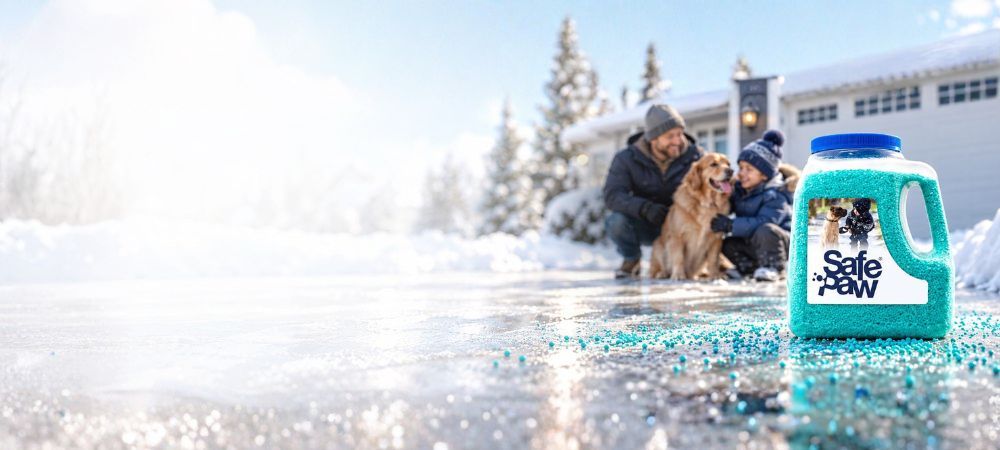
According to the Walk On Ice product specifications, Walk On Ice is a mineral-based traction agent made from a blend of naturally occurring minerals.
It is intended to add physical texture to slippery winter surfaces rather than chemically melt accumulated ice.
Walk On Ice is a traction agent, not an ice melter.
The manufacturer identifies intended uses including sidewalks, outdoor steps, driveways, decks, and localized icy areas around stationary vehicle tires.
Its product documentation also provides a chemical analysis for a tested mineral sample and a Safety Data Sheet under the Traction Magic trade name.
These documents provide composition and handling information. They do not establish that the product is universally harmless or independently superior to other traction materials.
Follow the manufacturer’s current application, handling, and cleanup instructions.
See Walk On Ice Product and Safety Documentation for additional information.
Frequently Asked Questions About Black Ice
Is Black Ice Actually Black?
No. It is usually transparent or nearly transparent, allowing the dark pavement underneath to remain visible.
Can Black Ice Form Above 32°F?
Yes, when the air temperature is above freezing but the pavement itself is cold enough for moisture to freeze. The University of Minnesota’s pavement-temperature guide provides examples of these conditions.
Why Is Black Ice Common in the Morning?
Rainwater or melted snow can refreeze overnight and remain on pavement during early morning travel.
Can Black Ice Form Without Rain?
Yes. Freezing fog can deposit ice on exposed surfaces without rainfall.
Why Are Bridges More Vulnerable to Black Ice?
Bridge decks are exposed to cold air from above and below and can cool faster than nearby ground-supported roads.
Can Deicers Melt Black Ice?
Yes. Appropriate deicers can melt or loosen ice, although effectiveness depends on the chemical, pavement temperature, and application conditions.
Does Sand Melt Black Ice?
No. Sand provides abrasive texture but does not chemically melt ice.
Does Walk On Ice Melt Black Ice?
No. Walk On Ice is a mineral-based traction agent designed to improve grip without melting the ice.
Final Thoughts
Black ice can be difficult to identify, so checking weather conditions and recognizing hazardous locations is essential.
The most important practical distinction is between air temperature and pavement temperature. A road may be icy even when the reported air temperature is slightly above freezing.
Drivers and pedestrians should exercise caution after precipitation, particularly around bridges, shaded surfaces, and areas where water accumulates.
Property owners can manage hazards through snow removal, drainage maintenance, appropriate deicing, and traction treatments.
A wet-looking road is not necessarily an ice-free road. When freezing conditions are possible, rely on weather information, official advisories, and appropriate winter precautions rather than appearance alone.
References and Scientific Sources
- National Weather Service — Ice Storms and Black Ice — Black ice appearance, refreezing, and early morning conditions.
- National Weather Service — Freezing Rain vs. Sleet — Freezing rain formation.
- National Weather Service — Freezing Fog — Supercooled droplets and surface icing.
- National Weather Service — Freezing Rain and Sleet — Bridge and overpass icing.
- University of Minnesota — Winter Salt Guide: Pavement Temperature — Approximate air and pavement temperature differences.
- Transportation Research Board — Road Weather Information Systems, Volume 2 — Page 46, pavement-versus-air-temperature conditions.
- Federal Highway Administration — Pavement Temperature Monitoring — Variation in pavement temperatures.
- National Weather Service — Winter Driving — Black ice awareness.
- Federal Highway Administration — Chemical Deicers and Concrete Pavement — Winter treatment functions.
- Walk On Ice — Product and Safety Documentation — Manufacturer product information.
Editorial note: This article provides general weather education and winter-safety information. Consult local forecasts, official road advisories, and current product instructions when making travel or maintenance decisions.