
Avoid aggressive acceleration, prolonged wheel spinning, reducing tire pressure, and attempting recovery near moving traffic.
The safest recovery method depends on snow depth, surface conditions, vehicle type, available equipment, and your vehicle manufacturer’s instructions.
Essential Safety Checks Before Getting Your Car Unstuck
Attempting to free a vehicle from snow without assessing the surroundings can result in personal injuries, vehicle damage, or exposure to carbon monoxide.
Before Attempting Vehicle Recovery
- Switch on your hazard lights to alert approaching drivers.
- Assess traffic conditions and avoid exiting the vehicle if doing so would expose you to moving traffic.
- Secure the vehicle and switch off the engine before clearing snow around it.
- Check that the exhaust pipe is free of snow before running the engine.
- Wear insulated gloves and suitable winter footwear.
- Ensure passengers and bystanders remain outside the vehicle’s potential path.
- Check your owner’s manual for vehicle-specific recovery instructions.
- Contact roadside assistance if recovery cannot be attempted safely.
Important Safety Warning: A snow-blocked exhaust pipe can allow dangerous carbon monoxide to accumulate inside a vehicle.
7 Effective Methods to Free Your Car From Snow
1. Stop Spinning Your Wheels
One of the most common mistakes drivers make when their car becomes stuck in snow is applying too much accelerator pressure.
Excessive wheel spinning can cause the tires to dig deeper into soft snow, compact snow beneath the vehicle, and reduce available traction. It may also place unnecessary stress on the tires and drivetrain.
Instead:
- Release the accelerator when the wheels begin spinning.
- Bring the vehicle to a complete stop.
- Evaluate the snow depth and available clearance.
- Avoid repeated attempts without improving the conditions around the tires.
The objective is to restore controlled tire grip rather than force the vehicle through the snow.
2. Clear Snow From Around the Tires and Vehicle
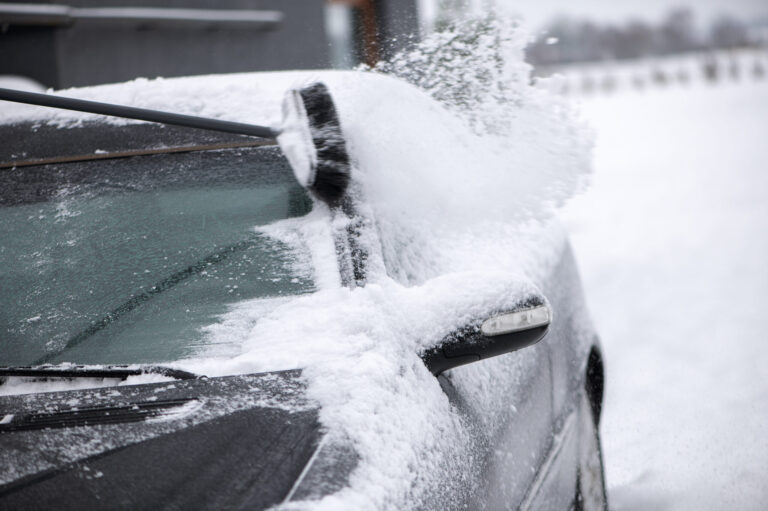
A compact snow shovel is one of the most useful tools to carry during winter.
Before attempting to move the vehicle, remove snow that may be restricting tire movement.
Focus on the following areas:
- Snow immediately in front of and behind the tires.
- Packed snow around the wheel wells.
- Accessible snow accumulation beneath the vehicle.
- Snow blocking the exhaust pipe.
- The intended direction of vehicle movement.
Create a gradual exit path instead of forcing the vehicle over a high ridge of compacted snow.
If the vehicle’s underbody is resting on deep snow, the tires may not have enough contact with the ground to generate traction. This condition may require professional recovery.
Safety precaution: Do not crawl underneath a stuck vehicle or use sharp tools that could damage the tires, brake lines, or underbody components.
3. Adjust the Direction of Your Front Wheels
The position of the front wheels can influence resistance when attempting to move a stuck vehicle.
Where conditions permit, straighten the front wheels toward a clear exit route. Turning them sharply against accumulated snow may increase resistance.
If snow is restricting wheel movement, clear the obstruction before attempting recovery.
Use small, controlled steering adjustments and avoid forcing the steering wheel against packed snow or other obstacles.
The correct approach depends on the vehicle’s drivetrain, surrounding terrain, and manufacturer recommendations.
4. Use Traction Boards or Suitable Traction Materials
When tires cannot grip a snow-covered or icy surface, suitable traction aids may help improve contact between the tires and the ground.
Purpose-designed vehicle recovery traction boards are an option when they are compatible with the vehicle and surface conditions.
Other materials may include:
- Coarse sand.
- Suitable mineral-based traction granules.
- Non-clumping cat litter as a temporary alternative.
Sand and other loose materials may provide additional grip, although their effectiveness depends on the underlying surface and amount of snow. Cat litter can become ineffective when saturated or compacted.
How to Use Traction Aids Safely
- Secure the vehicle and switch off the engine.
- Clear accumulated snow around the drive tires.
- Position the traction aid according to its instructions.
- Ensure everyone is clear of the vehicle and traction materials.
- Attempt to move using minimal accelerator pressure.
- Stop immediately if the wheels spin or the vehicle slides.
Avoid using ordinary vehicle floor mats as substitutes for purpose-designed recovery boards. Loose objects can be expelled by spinning tires and potentially cause injuries.
5. Use Gentle Acceleration and Appropriate Vehicle Settings
Once snow has been cleared and suitable traction materials are in place, attempt to move the vehicle slowly.
Apply only enough accelerator pressure to initiate controlled movement.
Some vehicles have dedicated settings for snow, slippery surfaces, or low-traction conditions. These settings may modify power delivery or traction management.
Depending on your vehicle, available settings may include snow mode, low-speed driving modes, or manufacturer-approved recovery settings.
Should You Turn Off Traction Control When Stuck in Snow?
Traction control should normally remain enabled. Some manufacturers permit temporary adjustments when a vehicle is stuck, but this is not appropriate for every vehicle.
Consult your owner’s manual before changing traction control settings. Restore normal settings once the vehicle is free.
Should You Reduce Tire Pressure to Get Unstuck From Snow?
No. Do not lower tire pressure as a roadside snow recovery method. Maintain or restore tire pressure according to your vehicle manufacturer’s recommendations. Underinflated tires can affect vehicle handling, tire performance, and safety.
Follow the recommended cold tire pressure specified on your vehicle’s tire information label or in the owner’s manual.
6. Rock the Vehicle Gently Only If the Manufacturer Permits It
Rocking involves limited forward and backward movement to help a vehicle move out of a shallow depression in snow.
However, this technique is not suitable for every vehicle or transmission system.
Before attempting this method, consult your owner’s manual.
If the manufacturer permits rocking:
- Ensure adequate space in both directions.
- Bring the vehicle to a complete stop before changing direction.
- Apply minimal accelerator pressure.
- Attempt only a few gentle movements within the manufacturer’s specified limits.
- Stop immediately if the tires spin or the vehicle does not make progress.
Do not continue rocking if you notice a burning smell, unusual noises, warning lights, overheating, or unexpected vehicle movement.
Ford’s vehicle-specific owner’s manual guidance explains that extended rocking can damage tires and transmission components or cause engine overheating. This illustrates why drivers should follow the instructions for their particular vehicle rather than applying a universal recovery technique.
7. Call Professional Roadside Assistance
Not every stuck vehicle can be recovered safely using basic tools or traction materials.
Professional assistance is the appropriate option when:
- The vehicle is stuck in deep or compacted snow.
- The underbody is resting on snow.
- The vehicle is near moving traffic.
- The vehicle is on a steep or slippery slope.
- There is a risk of sliding into a ditch.
- Visibility is poor.
- The vehicle displays mechanical or overheating warnings.
- Initial recovery attempts have failed.
Avoid improvised towing using ropes, chains, or unapproved vehicle attachment points. Incorrect recovery equipment or attachment methods can cause serious injuries and vehicle damage.
A professional recovery service can assess the situation and use equipment appropriate for the vehicle and surrounding conditions.
If there is an immediate danger to life or safety, contact emergency services.
Which Snow Recovery Method Should You Use?
The following table provides a practical decision guide for common winter vehicle recovery situations.
| Vehicle Condition | Recommended First Action | When to Stop |
|---|---|---|
| Tires spinning in shallow snow | Stop accelerating and clear snow. | Wheels continue spinning. |
| Tires surrounded by packed snow | Shovel around the tires. | Snow cannot be safely removed. |
| Tires resting on ice | Use suitable traction boards or materials. | Vehicle begins sliding sideways. |
| Vehicle resting on deep snow | Contact professional recovery assistance. | Avoid crawling underneath the vehicle. |
| Vehicle stuck near moving traffic | Turn on hazard lights and seek assistance. | Do not attempt unsafe roadside recovery. |
| Vehicle displaying warning lights | Stop recovery attempts. | Arrange professional assistance. |
| Vehicle stranded during a snowstorm | Contact help and follow winter survival guidance. | Avoid walking into poor visibility. |
These recommendations are general decision-support guidance rather than vehicle-specific recovery instructions.
What Should You Avoid When Your Car Is Stuck in Snow?
Certain recovery techniques can worsen the situation or create additional hazards.
| Common Mistake | Why It Should Be Avoided |
|---|---|
| Aggressive acceleration | Can worsen wheel spinning and reduce control. |
| Reducing tire pressure | Can compromise tire performance and handling. |
| Rapidly shifting between gears | May damage transmission components. |
| Prolonged vehicle rocking | Can overheat or damage vehicle components. |
| Running the engine with a blocked exhaust | Creates a carbon monoxide poisoning hazard. |
| Using ordinary floor mats for traction | Loose mats may be expelled by rotating tires. |
| Standing behind spinning tires | Exposes people to flying debris and unexpected vehicle movement. |
| Using improvised towing equipment | May cause attachment failure and serious injuries. |
If recovery attempts do not produce controlled progress, stop and seek assistance.
Optional Traction Product: Walk On Ice®
Manufacturer product information – separate from independent vehicle recovery guidance.
Walk On Ice® is a mineral-based traction agent designed to improve grip on suitable icy and snow-covered surfaces, including areas around stationary vehicle tires.
According to the manufacturer, the product contains naturally occurring minerals and is intended for temporary traction applications.
Walk On Ice is a traction aid rather than an ice-melting product. Its effectiveness depends on surface conditions, application, snow depth, and vehicle circumstances.
It should not be considered a guaranteed vehicle recovery solution or a substitute for traction boards, snow removal, appropriate winter tires, or professional roadside assistance.
Always follow the manufacturer’s application instructions.
Watch: Walk On Ice Product Demonstration
The following manufacturer-provided video demonstrates the product’s intended use. It should not be interpreted as independent testing or proof of guaranteed vehicle recovery performance.
What Should You Do If You Are Stranded in a Snowstorm?
If your vehicle cannot be freed during severe winter weather, prioritize personal safety rather than continuing unsuccessful recovery attempts.
The National Weather Service recommends remaining with your vehicle during severe snowstorms when the location is safe, because poor visibility can make it difficult to find shelter.
Take the following precautions:
- Contact emergency services or roadside assistance as appropriate.
- Share your location with a trusted person.
- Use available blankets and warm clothing to conserve body heat.
- Keep the exhaust pipe free of accumulated snow.
- Run the engine only intermittently for warmth when safe.
- Slightly open a window for ventilation when running the engine.
- Avoid unnecessary exposure to severe cold.
Source: National Weather Service – What to Do If You’re Caught in a Winter Storm.
Winter Emergency Kit for Your Car
Preparing your vehicle before winter can reduce the difficulties associated with unexpected snow and ice conditions.
| Essential Item | Purpose |
|---|---|
| Compact snow shovel | Removes snow from around tires. |
| Vehicle recovery traction boards | Provides additional tire grip. |
| Coarse sand or suitable traction material | May improve traction. |
| Insulated gloves | Protects hands during snow removal. |
| Winter boots | Provides foot protection and grip. |
| Warm blankets | Helps conserve body heat. |
| Flashlight and spare batteries | Improves visibility in darkness. |
| Portable phone charger | Supports emergency communication. |
| Reflective emergency equipment | Helps alert other motorists when safely deployed. |
| First-aid kit | Supports basic emergency care. |
| Drinking water and nonperishable food | Provides supplies during unexpected delays. |
| Ice scraper and snow brush | Helps clear windows and vehicle surfaces. |
Check your emergency supplies regularly throughout the winter season.
How to Prevent Your Car From Getting Stuck in Snow
Prevention is often safer and easier than attempting vehicle recovery.
Before driving during winter:
- Check weather forecasts and road conditions.
- Avoid unnecessary travel during severe winter storms.
- Maintain the manufacturer-recommended tire pressure.
- Check tire tread condition.
- Consider winter tires suitable for your vehicle and climate.
- Avoid driving through deep snow when possible.
- Accelerate, brake, and steer smoothly.
- Maintain additional following distance.
- Park in cleared areas whenever practical.
- Carry appropriate winter recovery equipment.
All-wheel drive and four-wheel drive can assist acceleration in some slippery conditions, but they do not eliminate the risks of becoming stuck or guarantee improved braking performance on snow and ice.
Frequently Asked Questions
1. What Is the Fastest Way to Get a Car Unstuck From Snow?
Stop wheel spinning, clear snow from the tires and intended exit route, use suitable traction aids, and apply gentle acceleration. The most effective method depends on the vehicle, surface conditions, and depth of snow.
2. Should I Let Air Out of My Tires If My Car Is Stuck in Snow?
No. Reducing tire pressure is not recommended as a general roadside snow recovery technique. Follow the tire-pressure specifications provided by your vehicle manufacturer.
3. Does Rocking a Car Help Get It Unstuck From Snow?
Rocking may help in some shallow-snow situations if the vehicle manufacturer permits it. Use only gentle movements, stop completely before changing direction, and discontinue the attempt if the vehicle does not make progress.
4. Should I Turn Off Traction Control When Stuck in Snow?
Some vehicle manufacturers allow temporary traction control adjustments during recovery. Consult your owner’s manual before changing these settings and restore normal operation afterward.
5. Can Sand Help Get a Car Unstuck From Snow?
Coarse sand may provide additional grip when tires are resting on slippery surfaces. Its effectiveness depends on the snow depth and underlying surface conditions.
6. Can Cat Litter Provide Traction Under Car Tires?
Non-clumping cat litter may provide temporary traction in some situations. However, it can become ineffective when wet or compacted. Suitable traction boards or purpose-designed traction materials are preferable when available.
7. Can Ice Melt Get a Car Unstuck From Snow?
Ice melt may help break down ice around stationary tires when used appropriately, but it does not necessarily provide immediate traction or remove deep snow. Check product suitability and follow its instructions.
8. What Should I Do If My Car Is Stuck in Deep Snow?
Assess traffic and weather hazards, clear accessible snow, and determine whether the vehicle’s underbody is resting on the snow. If safe, controlled movement is not possible, contact professional roadside assistance.
9. Can an All-Wheel Drive Car Get Stuck in Snow?
Yes. All-wheel drive vehicles can become stuck when tires lose grip, snow exceeds available ground clearance, or the vehicle encounters deep or compacted snow.
10. Why Should I Clear the Exhaust Pipe When My Car Is Stuck?
A snow-blocked exhaust pipe can cause carbon monoxide to accumulate inside the vehicle. Clear snow from the exhaust before operating the engine, and follow official winter emergency guidance.
11. When Should I Stop Trying to Free My Car From Snow?
Stop if the wheels continue spinning, the vehicle slides unexpectedly, warning lights appear, you smell burning, or recovery exposes anyone to traffic or other hazards. Call professional assistance when controlled recovery is not possible.
Conclusion
Getting your car unstuck from snow requires a controlled approach that prioritizes personal safety, vehicle protection, and suitable recovery methods.
Clearing accumulated snow, using appropriate traction aids, applying gentle acceleration, and following vehicle-specific recovery instructions may help in manageable situations.
Avoid reducing tire pressure, aggressive acceleration, prolonged rocking, and unsafe roadside recovery attempts.
When a vehicle cannot be freed safely, professional roadside assistance is the appropriate next step. Preparing a winter emergency kit and maintaining your vehicle before severe weather can also help reduce future recovery difficulties.
References and Authoritative Sources
- National Highway Traffic Safety Administration – Winter Driving Tips
Official winter driving guidance covering recommended tire pressure, vehicle preparation, emergency supplies, and exhaust pipe safety.
- National Weather Service – What to Do During a Winter Storm
Official winter storm safety recommendations, including precautions for motorists stranded in snow and severe weather.
- Ford Owner’s Manuals – Vehicle Operating and Recovery Instructions
Vehicle-specific manufacturer instructions covering operating procedures and applicable recovery limitations. Consult the manual for your exact vehicle model and year.
- AAA – Tips for Driving in the Snow
Additional guidance on winter driving preparation and precautions for snowy road conditions.
Editorial Transparency: This article is published by Walk On Ice, a winter traction product brand. General vehicle recovery and safety recommendations are based on the external resources cited above. Manufacturer product information is identified separately from independent safety guidance.
Safety Disclaimer: This article provides general educational information. Always follow your vehicle’s owner manual and seek professional assistance when recovery cannot be performed safely.
Absolutely, winter is a magical season, isn’t it? Snowflakes drifting down from the sky, covering everything in a blanket of soft, white snow. It’s a sight to behold. Until, of course, your car gets stuck in that beautiful snow. Then, not so magical. Don’t fret! It happens to the best of us. Whether you’re a seasoned driver or a newbie, getting your car stuck in the snow is something most of us have encountered at least once. The good news? There are several effective methods you can employ to free your vehicle.
How To Get A Car Unstuck From Snow:
Prepare Yourself and Your Vehicle
Before we dive into the tactics, it’s essential to be prepared. Always have a small bag of essential items in your car during winter. This should include gloves, a warm hat, a shovel, a bag of sand or cat litter, and some ‘Walk On Ice.’
Why ‘Walk On Ice’?
One of the best things to remember when it comes to how to get car unstuck from snow is Walk on Ice. When salt and ice melt fails, Walk On Ice works. Salt and ice melt take time to work, leaving the road slippery during the process. Also, they don’t work on black ice. Walk On Ice provides instant traction, hence saving road accidents. It’s handy (fits in a bag, glove box), 100% natural, and safe for pets, people, and your property. The suckers absorb the liquid layer of water and allow the grippers to lock into the ice, creating a stable non-skid surface to travel on by car or foot.
Let’s Get Unstuck!
- Don’t Spin Your Wheels
It’s a natural reaction to rev the engine and spin the wheels when you feel stuck. Resist this urge! Spinning your wheels too fast will only dig the car in deeper. Instead, try to move the car slowly forwards and then slowly back, in as straight a line as possible.
- Turn Your Steering Wheel
Turn your steering wheel from side to side before you start your car. This will create a path for the tires to follow.
- Shovel Around Your Tires
Dig out the snow from around the tires and the underside of your car. If you don’t have a shovel, you can use your hands or any other available object. Be careful not to hurt yourself!
- Use Your Car Mats
Car mats can be a lifesaver. Take out your car mats and place them under the tires, with the tips pointing in the direction you want to go. This will create traction and help the tires grip the surface.
- Add Some Traction
Sprinkle some ‘Walk On Ice’ around the tires. This will create instant traction on all icy surfaces and make it easier for your car to move. Remember, when salt and ice melt fails, ‘Walk On Ice’ works!
- Let Some Air Out Of Your Tires
This may sound counterintuitive, but reducing your tire pressure by about 10 psi will increase the surface area of the tire in contact with the ground, improving traction.
- Rock Your Car
Gently shift your car from forward to reverse, and back again. Each time you’re in gear, give a light touch on the gas until the car moves.
- Ask For Help
Don’t be shy about asking for help. Sometimes, all you need is a little push to get your car moving. If you are in a remote area, it is especially crucial to call for help early on. Hope you have a better clarity on ‘how to get a car unstuck from snow”.
Conclusion
Getting stuck in the snow can be frustrating, but it’s essential to remain calm and think logically. With these effective methods and the help of ‘Walk On Ice,’ you’ll be back on the road in no time. Remember to drive carefully and adjust your driving according to the road conditions. Stay safe!
And there you have it! A step-by-step guide on how to get a car unstuck from snow. Don’t forget to keep a bag of ‘Walk On Ice’ in your car. It’s not just handy for getting your car unstuck, but also for creating a non-skid surface for walking. Stay warm and safe this winter!