The safest recovery method depends on why the car is stuck. Packed snow, slippery ice, and snow trapped underneath the vehicle require slightly different approaches.
Quick Answer: How Do You Get a Car Unstuck From Snow?
First, check that the exhaust pipe is clear and the surrounding area is safe. Remove packed snow around the tires and underneath the vehicle. Straighten the wheels, accelerate gently, and use suitable automotive traction aids if needed. Rock the vehicle only if the owner’s manual permits it. If recovery is unsuccessful or unsafe, contact roadside assistance.
1. Assess the Situation and Check for Safety Hazards
Before attempting recovery, turn off the engine when safe, activate your hazard lights when necessary, and examine why your vehicle is stuck.
Determine whether the tires are buried in snow, spinning on ice, or unable to grip because the vehicle is resting on packed snow underneath.
Quick Recovery Decision Guide
| Problem | Recommended First Action |
|---|---|
| Tires buried in snow | Clear snow around the drive tires and create a path for movement. |
| Wheels spinning on ice | Use an appropriate automotive traction aid and accelerate gently. |
| Vehicle stuck on snow underneath | Remove accessible snow beneath the vehicle. Never crawl under an unsupported car. |
| Vehicle still stuck | Stop unsuccessful attempts and call roadside assistance. |
These approaches are consistent with AAA’s guide to getting a car unstuck from snow, particularly its sections on clearing snow, improving traction, and requesting assistance.
Essential Safety Check: Clear the Exhaust Pipe
Before restarting the engine, make sure the exhaust pipe is not blocked by snow.
A blocked exhaust can allow dangerous carbon monoxide to accumulate inside the passenger compartment.
Carbon monoxide is odorless and can cause serious poisoning. If you experience dizziness, headache, nausea, or other suspected exposure symptoms, turn off the engine, move to fresh air when safe, and contact emergency services.
AAA specifically warns against restarting a snowbound vehicle without clearing the tailpipe.
Source: AAA — Know What Not to Do.
What Should You Do if Stranded During a Snowstorm?
The National Weather Service’s winter-storm safety guidance advises stranded drivers to remain with their vehicles when possible rather than risk becoming disoriented in blowing snow.
Follow this safety checklist:
- Stay with your vehicle when it is safer than walking into severe weather or traffic.
- Keep the exhaust pipe clear of accumulating snow before operating the engine.
- Use the engine for warmth only as needed. NWS guidance recommends approximately 10 minutes per hour in appropriate circumstances.
- Open a window slightly while the engine runs to allow fresh air and reduce carbon monoxide risk.
- Make your vehicle visible using hazard lights or a suitable distress signal.
- Contact emergency services if you are in immediate danger, and follow current local emergency instructions.
Do not run an engine if the exhaust cannot be kept clear. For electric or hybrid vehicles, follow the vehicle’s emergency instructions rather than assuming conventional engine guidance applies.
2. Clear Snow Around the Tires and Underneath the Vehicle
One of the most effective first steps is to remove packed snow preventing the wheels from moving.
Use a snow shovel to clear snow in front of and behind the tires. Create a short, unobstructed path in the intended direction of travel.
Focus on the drive wheels:
- Front-wheel drive: Clear the front tires.
- Rear-wheel drive: Clear the rear tires.
- All-wheel drive: Clear all four tires.
What if Your Vehicle Is High-Centered?
A high-centered vehicle is resting on packed snow or ice underneath, reducing the weight supported by its tires.
Even good winter tires may struggle when they cannot maintain sufficient contact with the surface.
Remove accessible snow beneath the vehicle where safe. Never crawl underneath an unsupported vehicle or reach near moving components.
AAA’s Clear the Snow and Ice Around Your Car section specifically recommends removing snow beneath the vehicle and creating enough space for the tires to move.
Source: AAA — Clearing Snow Around a Stuck Vehicle.
3. Improve Tire Traction With Suitable Recovery Aids
If your tires spin without moving the car, they may not have enough traction.
Snow and ice reduce friction between the tire and road surface, making forward or backward movement difficult.
Depending on vehicle compatibility and conditions, suitable recovery aids include:
- Purpose-made automotive traction boards.
- Manufacturer-approved tire traction devices.
- Gritty materials such as sand.
Where Should You Place Traction Aids?
Place a suitable traction aid directly in the intended path of the drive tire, following its manufacturer’s placement instructions.
If moving forward: Position the approved aid in front of the drive tire.
If reversing: Position it behind the drive tire.
Apply the parking brake and secure the stationary vehicle before approaching its tires. Keep everyone clear before attempting to move.
Do not stand in the vehicle’s path or beside spinning wheels. Loose objects may be ejected from beneath a tire.
AAA discusses placing traction materials ahead of or behind drive wheels in its Add Traction Under Your Wheels section and warns that materials can be thrown out during acceleration.
Source: AAA — Traction Materials and Placement.
For a vehicle-specific example, the 2025 Toyota Corolla Hybrid owner’s manual — If the vehicle becomes stuck describes clearing snow around the front wheels and positioning suitable material to help regain traction.
Important: Follow the traction-aid manufacturer’s placement instructions and your vehicle’s recovery guidance. Recommendations vary by vehicle and equipment. Purpose-made automotive traction boards are preferable to improvised loose floor mats.
4. Straighten the Wheels and Accelerate Gently
Once the snow has been cleared and the recovery path is safe, return to the driver’s seat.
Straighten the steering wheel where practical and select the appropriate gear.
Apply gentle accelerator pressure to move slowly.
Avoid aggressive acceleration. Excessive wheelspin can dig the tires deeper into snow, worsen traction, or damage vehicle components.
AAA discusses straightening the wheels and using controlled throttle in its Rock the Vehicle section.
Source: AAA — Gentle Acceleration and Recovery.
Should You Disable Traction Control?
Some vehicles permit temporary traction-control adjustments to help recover from snow or mud.
However, the correct settings vary by vehicle.
For example, the Toyota Corolla Hybrid manual’s stuck-vehicle section describes a traction-control adjustment for that specific model.
This does not mean traction control should always be disabled.
Check the traction-control or emergency recovery section of your own owner’s manual before changing settings. Restore normal operation after recovery as instructed.
5. Rock the Vehicle Only When the Owner’s Manual Permits It
Rocking involves small forward and backward movements to build sufficient momentum to escape shallow snow ruts.
It may help in certain situations, but improper rocking can damage transmission or drivetrain components.
How to Rock a Car Out of Snow
If your vehicle manufacturer permits this technique:
- Ensure the area around the vehicle is clear.
- Select the appropriate forward gear.
- Apply light acceleration to move a short distance.
- Brake and bring the vehicle and wheels to a complete stop.
- Shift into reverse only after stopping.
- Move backward gently and repeat only a few controlled attempts, if permitted.
Do not shift while the vehicle is moving or the accelerator is depressed.
AAA’s Rock the Vehicle section describes controlled forward and reverse movements and emphasizes coming to a complete stop before shifting gears.
Source: AAA — Vehicle Rocking Technique.
The 2025 Toyota Corolla Hybrid owner’s manual — If the vehicle becomes stuck also warns about sudden vehicle movement, excessive wheelspin, and improper shifting.
When should you stop?
Stop immediately if the tires spin continuously, the vehicle does not move after a few attempts, you hear unusual mechanical sounds, or the drivetrain shows signs of overheating.
Consult the “stuck vehicle” or emergency recovery section of your owner’s manual before rocking or changing traction-control settings. Procedures vary by make and model.
If you cannot recover the vehicle safely, call roadside assistance.
6. Stop and Request Roadside Assistance When Necessary
Not every vehicle can be safely recovered with a shovel and traction equipment.
Continued attempts may worsen the situation or cause mechanical damage.
Call roadside assistance when:
- The vehicle remains stuck after reasonable attempts.
- Packed snow underneath prevents tire contact.
- The vehicle is near traffic, a ditch, or a steep slope.
- Unusual noises, overheating, or mechanical problems occur.
- Severe weather makes outdoor recovery dangerous.
Do not attach towing equipment to unapproved vehicle components.
AAA’s Request Roadside Assistance section recommends professional assistance when basic recovery techniques fail.
Source: AAA — When to Request Roadside Assistance.
Manufacturer-Described Option: Walk On Ice
This section describes a manufacturer’s product application, not an independently verified vehicle recovery method.
Walk On Ice is a mineral traction product marketed by Gaia Enterprises for localized use on icy and snowy outdoor surfaces.
According to the manufacturer’s Walk On Ice application guidance, the granules may be applied to the ground at a stationary tire’s contact point and in the intended direction of movement.
The manufacturer describes the product as adding surface texture rather than melting the underlying ice.
However, no independent comparative performance testing is cited in this article. Results can vary with surface conditions, snow depth, temperature, and tire condition.
For vehicle recovery, prioritize suitable automotive traction equipment or professional roadside assistance when necessary.
Commercial disclosure: Walk On Ice is a Gaia Enterprises product, and this article appears on the brand’s website.
Read the official Walk On Ice usage and safety FAQs before application.

How to Prevent Your Car From Getting Stuck in Snow
Winter preparation can help reduce the risk of becoming stranded.
Use Appropriate Winter Tires
Use tires suitable for the temperatures and driving conditions you expect. Maintain recommended tire pressure and inspect tread condition regularly.
Carry Winter Emergency Supplies
Keep a snow shovel, ice scraper, flashlight, warm clothing, blankets, phone charger, and appropriate recovery equipment in the vehicle.
The National Weather Service recommends carrying a winter survival kit and preparing your vehicle before winter travel.
Clear Snow Before Driving
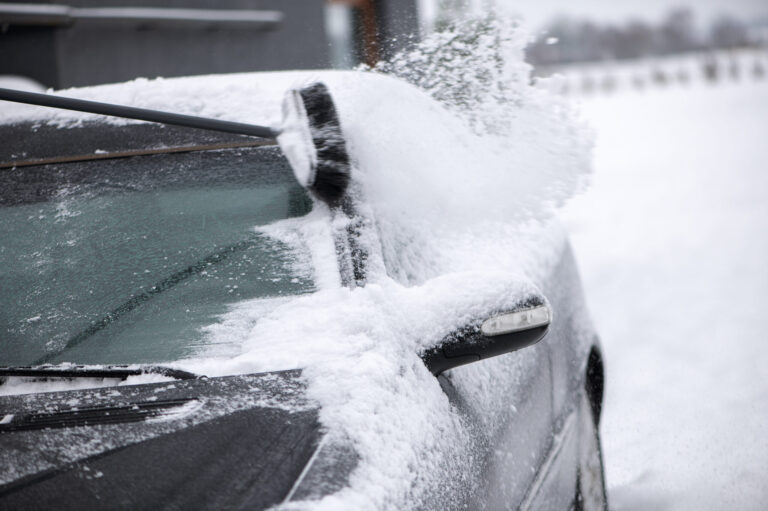
Remove snow from windows, headlights, mirrors, the roof, and the vehicle’s immediate path before driving.
Monitor Winter Weather
Check weather forecasts, road conditions, and local alerts. Avoid unnecessary travel during severe storms.
Frequently Asked Questions
What is the easiest way to get a car unstuck from snow?
First, ensure the exhaust is clear and the location is safe. Remove packed snow around the drive tires and underneath the car, straighten the wheels, and accelerate gently. Use suitable traction aids if needed.
What should I put under my tires when stuck in snow?
Purpose-made automotive traction boards or appropriate gritty materials such as sand may help. Place approved aids in the intended direction of drive-tire movement, according to the equipment instructions.
Why are my tires spinning but my car is not moving?
The tires may lack traction on snow or ice. The vehicle may also be high-centered on packed snow, reducing effective tire contact.
Can rocking a car damage the transmission?
Yes. Excessive wheelspin, aggressive acceleration, and improper gear changes can damage drivetrain components. Rock the vehicle only when its owner’s manual permits it.
Should I turn off traction control when stuck in snow?
Some manufacturers permit temporary adjustments in specific recovery situations. Consult your vehicle’s owner’s manual rather than applying the same rule to every car.
Can Walk On Ice help when a car is stuck?
According to its manufacturer, Walk On Ice can be applied around the tire-contact area of a stationary vehicle for localized traction. This is a manufacturer-described use, not a guarantee of successful recovery.
What should I do if stranded in a snowstorm?
Follow the National Weather Service’s stranded-vehicle guidance. Remain with the vehicle when safer than walking, keep the tailpipe clear, maintain ventilation when operating the engine, and contact emergency services when necessary.
Conclusion
Getting a car unstuck from snow requires the right technique, suitable recovery equipment, and an understanding of vehicle safety.
Start by checking the exhaust pipe and surrounding area. Clear snow around the tires, improve traction when necessary, and use gentle acceleration.
Only attempt rocking if your vehicle manufacturer allows it, and stop when recovery becomes unsafe or unsuccessful.
By following established winter safety guidance and keeping emergency supplies available, drivers can respond more confidently to snow-related vehicle problems.